Best Beginner Telescope for Adults: Starter Telescopes for Astronomy and Planet Viewing
Buying your first telescope should be exciting, not confusing. Yet beginners are immediately faced with refractors, reflectors, aperture sizes, focal lengths, equatorial mounts and smart telescopes before they have even looked at the Moon.
The best beginner telescope for adults is usually one that is easy enough to set up that you will actually use it, but capable enough to keep astronomy interesting once the novelty of looking at the Moon has worn off.


For some people, that means a traditional refractor telescope that can be carried into the garden and set up in minutes. Others may prefer the greater light-gathering ability of a Newtonian reflector. And if you want astronomy without spending your first few evenings learning how to manually locate objects, a modern smart telescope such as the DWARFLAB Dwarf Mini offers a very different approach.
In this guide, we look at four very different options for anyone searching for a starter telescope for adults, including telescopes for observing the Moon and planets, portable travel telescopes and a smart telescope for digital astronomy.
Best Beginner Telescopes for Adults at a Glance
| Telescope | Type | Best for | Buy |
|---|---|---|---|
| DWARFLAB Dwarf Mini Smart Telescope | Smart digital telescope | Easy astronomy, portability and astrophotography | Buy on Amazon |
| 80/600 Astronomical Refracting Telescope with AZ Mount | Refractor | Traditional beginner astronomy | Buy on Amazon |
| 130EQ Newtonian Reflector Telescope | Reflector | Planets, Moon and progressing beyond beginner level | Buy on Amazon |
| 80mm Aperture 600mm Travel Telescope | Refractor | Portable astronomy and beginners | Buy on Amazon |
What Is the Best Beginner Telescope for Adults?
There isn’t one telescope that suits every beginner.
A useful way to choose your best first telescope for adults is to decide how you actually expect to use it.
Do you want to walk outside after dinner and quickly look at the Moon?
Would you like a telescope for adults to see planets such as Jupiter and Saturn?
Are you interested in astrophotography?
Do you want something compact enough to take camping or on holiday?
Or are you willing to learn how to use a more substantial telescope in return for greater astronomical potential?
For ease of use, a straightforward refractor is difficult to beat. For greater light gathering and a more traditional enthusiast’s telescope, a larger Newtonian reflector can be a better long-term purchase. Smart telescopes are meanwhile making astronomy accessible to people who are more interested in seeing and photographing celestial objects than learning manual star-hopping.
1. DWARFLAB Dwarf Mini Smart Telescope – Best Smart Telescope for Beginners

The DWARFLAB Dwarf Mini Smart Telescope takes a very different approach to beginner astronomy.
Rather than being primarily designed around looking through a conventional eyepiece, smart telescopes combine optics, digital imaging and automated object locating.
That potentially removes one of the biggest frustrations facing newcomers: knowing that an interesting galaxy, nebula or star cluster is somewhere above you but having absolutely no idea where to point the telescope.
Buy the DWARFLAB Dwarf Mini Smart Telescope on Amazon
Why It Makes a Good Starter Telescope for Adults
The headline advantage is convenience.
At around 1.85 lb, the Dwarf Mini is exceptionally portable compared with many traditional telescope and tripod combinations.
That makes it appealing if you live somewhere with significant light pollution and want to travel to darker skies.
It is also potentially a good choice for:
- camping trips
- holidays
- garden astronomy
- beginner astrophotography
- digitally sharing astronomy images
- people who prefer technology-assisted astronomy
- users without room to store a large telescope
A traditional telescope can take some learning. You need to understand the mount, locate objects and often become familiar with different eyepieces.
A smart telescope shifts more of that work onto software.
Is the Dwarf Mini Good for Planets?
If your overriding goal is traditional visual observation of planets through an eyepiece, a conventional telescope may be the better choice.
The DWARLAB approach is more about digital observation and imaging.
That makes it particularly interesting for someone whose idea of astronomy involves capturing images, identifying objects and exploring the night sky using connected technology.
Who Should Buy It?
Choose the DWARFLAB Dwarf Mini if you want your first astronomy experience to be portable, automated and digitally focused.
It could be especially attractive to photographers, technology enthusiasts or people who don’t want a large telescope permanently occupying a corner of the house.
Best for: smart astronomy, portability and beginners interested in astrophotography.
Check the DWARFLAB Dwarf Mini price on Amazon
2. 80/600 Astronomical Refracting Telescope – Best Traditional Starter Telescope for Adults
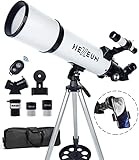
A refractor is what most people imagine when somebody says “telescope”.
This Astronomical Refracting Telescope for Adults and Astronomy Beginners uses an 80/600-style optical configuration and comes with an AZ mount.
Buy the beginner refracting telescope on Amazon
For someone buying their first telescope, this sort of design has several advantages.
Simple Refractor Design
Refracting telescopes use lenses rather than a mirror-based optical system.
One of the reasons they remain popular with beginners is that they can be relatively straightforward to operate.
Set up the tripod and mount, point the telescope towards an object, focus the image and start observing.
That relative simplicity makes a refractor a strong candidate for the best first telescope for adults who don’t want an excessively steep learning curve.
80mm Aperture
Aperture is one of the most important specifications on any telescope.
It refers to the diameter of the telescope’s main light-gathering lens or mirror.
In general, a larger aperture collects more light, potentially revealing fainter objects and more detail.
An approximately 80mm refractor represents a useful entry point into amateur astronomy. It remains manageable and portable while offering considerably more astronomical capability than simply looking at the sky with the naked eye.
600mm Focal Length
The telescope’s 600mm focal length provides a useful basis for both relatively wide views and higher magnification when paired with appropriate eyepieces.
Remember that telescope magnification isn’t determined by the telescope alone.
You calculate it using:
Telescope focal length ÷ eyepiece focal length = magnification
For example, a 600mm telescope used with a 10mm eyepiece would theoretically provide:
600 ÷ 10 = 60x magnification
Don’t become obsessed with enormous magnification numbers, though.
A sharp, stable view at moderate magnification is normally much more enjoyable than a huge but blurry image.
Fully Multi-Coated Optics
This telescope is advertised with fully multi-coated high-transmission coatings.
Optical coatings are designed to improve light transmission and reduce unwanted reflections, potentially helping deliver a clearer and brighter image.
AZ Mount
An alt-azimuth or AZ mount is another useful beginner feature.
It essentially allows you to move the telescope:
- up and down
- left and right
That feels intuitive and can make an AZ telescope considerably less intimidating than a more complicated equatorial mount.
Who Is It Best For?
This is perhaps the most conventional starter telescope for adults in our selection.
It’s particularly suited to someone who wants to learn astronomy through direct visual observation rather than having software do most of the work.
Best for: beginners wanting a straightforward traditional telescope.
Buy the 80/600 beginner telescope on Amazon
3. 130EQ Newtonian Reflector – Best Beginner Telescope for Adults to See Planets
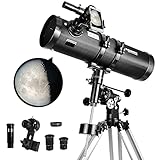
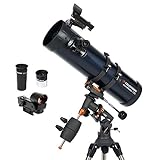
If you’re particularly interested in finding a telescope for adults to see planets, the 130EQ Newtonian reflector deserves serious consideration.
Its headline specification is its 130mm aperture.
That’s substantially larger than the 80mm refractors covered elsewhere in this guide.
Buy the 130EQ Newtonian Reflector Telescope on Amazon
Why Aperture Matters
A telescope is essentially a light collector.
Increasing the aperture allows it to collect more light.
That can improve your ability to observe not only bright targets such as the Moon and planets but also fainter deep-sky objects under suitable conditions.
A 130mm reflector therefore offers more room to develop your astronomy hobby than many small entry-level telescopes.
Telescope for Adults to See Planets
For many beginners, planets are the big attraction.
Depending on their position, atmospheric conditions, eyepieces and the quality of your setup, suitable telescopes can reveal sights including:
- the Moon’s craters and mountain shadows
- Jupiter and its major moons
- Jupiter’s main cloud bands
- Saturn and its rings
- phases of Venus
- Mars as a small reddish disc when favourably positioned
Seeing Saturn’s rings through your own telescope for the first time remains one of the classic moments in amateur astronomy.
The 130mm aperture makes this Newtonian particularly interesting if planetary observation is high on your priority list.
1.5x Barlow Lens
The telescope package includes a 1.5x Barlow lens.
A Barlow effectively increases the magnification produced by compatible eyepieces.
For example, if your telescope and eyepiece combination normally provided 80x magnification, a 1.5x Barlow would theoretically increase this to around 120x.
Again, higher is not automatically better.
Atmospheric turbulence, optical quality and telescope stability all influence how much magnification is genuinely useful.
Smartphone Adapter
The included smartphone adapter adds another appealing feature for beginners.
It gives you an opportunity to experiment with photographing suitable bright objects through the telescope using your phone.
The Moon is an obvious starting point.
Smartphone astronomy can be surprisingly addictive. Once you’ve captured a recognisable lunar crater or even managed a basic image of a planet, you may quickly find yourself experimenting with more advanced techniques.
Moon Filter
The package also lists a 13% transmission Moon filter.
The full or near-full Moon can appear extremely bright through a telescope.
A Moon filter reduces the amount of incoming light, potentially making viewing more comfortable and helping improve perceived contrast.
Equatorial Mount
The “EQ” in 130EQ normally refers to an equatorial mount.
This is more complicated than a simple AZ mount, so there’s a trade-off.
An equatorial mount requires more learning but is designed around following celestial objects as the Earth rotates.
If you’re happy to learn how to set it up properly, it can be a rewarding system.
Is It Suitable for a Complete Beginner?
Yes, but it suits a different kind of beginner.
If you want something you can casually point at the Moon with minimal preparation, an AZ-mounted refractor is probably easier.
If you’re interested enough in astronomy to learn how your equipment works, the 130EQ could offer significantly more long-term potential.
Best for: planetary observing, Moon viewing and beginners who expect astronomy to become a serious hobby.
Check the 130EQ Newtonian Telescope on Amazon
4. 80mm Aperture 600mm Refractor Telescope – Best Portable Beginner Telescope

Our final option combines an 80mm aperture with a 600mm focal length in a portable refractor package.
It also comes with a backpack, making it particularly interesting for anyone who wants astronomy equipment they can easily travel with.
Buy the 80mm Aperture 600mm Travel Telescope on Amazon
Why Portability Matters More Than You Think
People understandably focus on magnification and aperture when shopping for telescopes.
But there’s another specification that might matter even more:
Will you actually use it?
A technically impressive telescope isn’t particularly useful if:
- it takes half an hour to set up
- you don’t have anywhere to store it
- it’s too heavy to move comfortably
- you can’t transport it to darker skies
A compact telescope stored in a backpack can be taken to locations where a much larger instrument might stay at home.
And because light pollution has such a significant impact on astronomy, being able to travel away from towns and cities can dramatically improve the experience.
80mm Aperture
The 80mm objective lens provides a good balance between size and portability.
It should make the telescope suitable for beginner observations of bright astronomical objects while remaining manageable enough for travel.
600mm Focal Length
A 600mm focal length also makes this a versatile beginner configuration.
With different eyepieces, you can experiment with relatively low-power wide views as well as higher magnifications for targets such as the Moon and planets.
Travel Backpack
The backpack is perhaps the standout feature for certain users.
This could make it a good telescope for:
- camping
- caravan holidays
- dark-sky trips
- weekends away
- countryside stargazing
- taking to a holiday cottage
If you already spend time hiking, camping or travelling to rural areas, combining those trips with astronomy can be particularly rewarding.
Best for: portable astronomy, travel and beginners without much storage space.
Buy the 80mm travel telescope on Amazon
Which Is the Best First Telescope for Adults?
Here’s the simplest way to choose.
Choose the DWARFLAB Dwarf Mini if…
You want a highly portable smart telescope and are attracted to automated astronomy and digital imaging rather than exclusively looking through an eyepiece.
View the DWARFLAB Dwarf Mini on Amazon
Choose the 80/600 AZ Refractor if…
You want a straightforward traditional starter telescope for adults that provides a familiar, relatively simple introduction to astronomy.
View the 80/600 beginner refractor on Amazon
Choose the 130EQ Newtonian if…
You particularly want a telescope for adults to see planets, value the larger 130mm aperture and don’t mind spending time learning how to use an equatorial telescope properly.
View the 130EQ Newtonian Telescope on Amazon
Choose the 80mm Travel Telescope if…
Portability matters. Its combination of 80mm aperture, 600mm focal length and backpack makes it especially convenient for trips to darker observing locations.
View the portable 80mm telescope on Amazon
Refractor vs Reflector Telescope for Beginners
One of the first decisions when searching for the best beginner telescope for adults is whether to buy a refractor or reflector.
Refractor Telescope
A refractor uses a large objective lens at the front of a tube.
Advantages
Refractors can be:
- simple to understand
- relatively low maintenance
- quick to set up
- good for lunar and planetary observing
- compact at beginner aperture sizes
They’re an excellent choice if simplicity matters.
Newtonian Reflector Telescope
A Newtonian reflector uses mirrors rather than a large front objective lens.
Advantages
Reflectors frequently provide:
- larger aperture for the money
- greater light-gathering capability
- good planetary performance
- better access to fainter deep-sky targets
Their disadvantage is that they can require a little more understanding and maintenance.
A reflector may occasionally require collimation, which means aligning its mirrors correctly.
That sounds intimidating initially but becomes routine for many astronomy enthusiasts.
What Can You See With a Beginner Telescope?
Expectations matter.
Your telescope isn’t going to provide the enormous, intensely colourful views seen in processed NASA images.
But that doesn’t mean the real thing is disappointing.
Quite the opposite.
There is something extraordinary about seeing light from another planet directly through an instrument you’ve set up yourself.
The Moon
The Moon is probably your first and easiest target.
Even an entry-level telescope can reveal:
- craters
- mountain ranges
- shadows
- lunar seas
- dramatic detail around the terminator
Interestingly, a full Moon isn’t necessarily the best time for detailed lunar viewing.
When part of the Moon is illuminated, shadows close to the boundary between its light and dark sides can make craters and mountains appear much more dramatic.
Jupiter
Jupiter is another brilliant beginner target.
A suitable telescope can reveal Jupiter as a disc rather than simply a point of light.
Its four famous Galilean moons — Io, Europa, Ganymede and Callisto — can also frequently be observed.
Watch over several nights and you’ll notice that their positions change as they orbit Jupiter.
Saturn
Saturn is arguably the planet beginners most want to see.
Its rings make it unmistakable.
It won’t fill the eyepiece like a photograph from a spacecraft, but even seeing a tiny Saturn with its rings clearly separated from the planet can be an unforgettable experience.
Venus
Venus is extremely bright and shows phases somewhat like the Moon.
You shouldn’t expect to see detailed surface features because Venus is permanently covered in thick cloud.
Its changing phase is the interesting part.
Mars
Mars can be more challenging.
When relatively close to Earth, a decent beginner telescope can reveal the planet as an obvious orange-red disc.
At less favourable times, it can appear frustratingly small.
What Telescope Magnification Do I Need to See Planets?
Avoid buying a telescope because its packaging advertises enormous magnification.
Claims of 500x or 600x magnification can sound impressive but tell you surprisingly little about the telescope’s real-world quality.
Useful magnification depends on several things:
- aperture
- optical quality
- eyepiece
- atmospheric seeing
- stability of the mount
- the object being observed
Many rewarding planetary observations take place between roughly 50x and 150x, although larger good-quality telescopes under excellent conditions can sometimes support considerably more.
Sharpness matters more than an impressive-looking number.
Why Aperture Matters When Choosing a Starter Telescope
If you remember one telescope specification, make it aperture.
Aperture determines how much light your telescope collects.
The larger the aperture, the more light enters the telescope.
This can provide:
- brighter views
- greater resolution
- more detail
- access to fainter objects
This is one reason the 130EQ reflector stands out among the traditional telescopes in this comparison.
Its 130mm aperture has significantly more light-gathering area than an 80mm telescope.
However, larger telescopes are also typically less portable.
That’s why the best telescope isn’t necessarily the one with the largest aperture you can afford.
Don’t Ignore the Telescope Mount
Beginners often focus entirely on the telescope tube and optics.
The mount is equally important.
A fantastic telescope on a wobbly tripod can be infuriating.
At high magnification, even tiny movements are exaggerated. Touch the focusing knob and the entire image may start shaking.
A stable mount makes astronomy dramatically more enjoyable.
AZ Mount
An alt-azimuth mount moves vertically and horizontally.
It is intuitive and usually easy for beginners.
EQ Mount
An equatorial mount follows the apparent movement of stars and planets across the sky.
It is more complicated to learn but can offer greater control once correctly aligned.
For a casual beginner, AZ is probably easier.
For someone who wants astronomy to become a long-term hobby, learning an EQ mount can be worthwhile.
Is a Smart Telescope Better for Beginners?
For some people, absolutely.
Traditional amateur astronomy often involves:
- learning constellations
- aligning a finder
- locating a target
- selecting an eyepiece
- focusing carefully
- manually tracking the object
Some people love this process.
Others primarily want to see what’s up there.
Smart telescopes automate much of the locating, tracking and imaging process.
They’re therefore potentially excellent for beginners who might otherwise become frustrated by traditional telescope operation.
However, if your dream is putting your eye to an eyepiece and personally seeing Saturn hanging in space, you’ll probably prefer a conventional telescope.
Neither approach is inherently better. They’re simply different ways of enjoying astronomy.
Do You Need Dark Skies to Use a Telescope?
Not always.
You can observe the Moon and bright planets from surprisingly light-polluted locations.
That means a suburban garden can still provide excellent astronomy.
However, dark skies become increasingly important when you start looking for fainter objects such as:
- galaxies
- nebulae
- faint star clusters
If you live in a brightly illuminated city, portability becomes particularly valuable.
This is where lightweight smart telescopes and travel refractors begin to make considerable sense.
Beginner Telescope Buying Checklist
Before choosing your first telescope, consider:
Aperture: Larger apertures collect more light.
Mount: A stable mount matters enormously.
Portability: Will you realistically carry and set it up?
Storage: Larger reflectors need significantly more room.
Ease of use: A simple telescope that gets used is better than a complicated one gathering dust.
Planetary viewing: Look for adequate aperture and useful magnification rather than gimmicky maximum magnification claims.
Astrophotography: Smartphone adapters can provide an introduction, while smart telescopes offer a much more digitally focused experience.
Budget: Leave room for future accessories rather than necessarily spending your entire budget on the telescope itself.
Best Beginner Telescope for Adults FAQ
What is the best beginner telescope for adults?
For a traditional beginner telescope, an 80mm refractor on a simple AZ mount provides an appealing combination of ease of use, portability and useful astronomy capability.
For someone willing to learn a more complicated telescope, a 130mm Newtonian reflector offers greater aperture and potentially more room to progress.
For digital astronomy and astrophotography, a smart telescope such as the DWARFLAB Dwarf Mini provides a completely different beginner experience.
What is the best starter telescope for adults?
A good starter telescope for adults should be easy to set up, have a stable mount and provide enough aperture to make observing worthwhile.
Avoid choosing purely according to advertised magnification.
A well-made 80mm refractor can make a much better starter telescope than a poor-quality instrument boasting unrealistic magnification numbers.
What is a good telescope for adults to see planets?
A telescope with decent aperture and stable optics can show planets including Jupiter, Saturn, Mars and Venus.
Of the models featured here, the 130EQ Newtonian reflector is particularly interesting for planetary observation because of its larger 130mm aperture.
Can a beginner telescope see Saturn’s rings?
Yes.
Saturn’s rings are visible through many decent beginner telescopes when Saturn is favourably positioned and atmospheric conditions are suitable.
You don’t need a huge professional telescope.
Can you see Jupiter with a beginner telescope?
Yes.
Jupiter is one of the easiest planets for beginner astronomers.
Its four large Galilean moons can frequently be seen through relatively modest telescopes.
With appropriate magnification and conditions, you may also make out Jupiter’s main atmospheric bands.
Is an 80mm telescope good for beginners?
An 80mm refractor can be an excellent beginner telescope.
It is large enough to make lunar and planetary astronomy rewarding while remaining compact enough for convenient storage and transport.
Is a 130mm telescope good for beginners?
Yes, particularly if the beginner is serious about learning astronomy.
A 130mm reflector gathers considerably more light than a smaller beginner refractor and offers greater potential for exploring deep-sky objects.
The trade-off is greater size and potentially more complicated setup.
Is a smart telescope good for beginners?
Smart telescopes can be particularly accessible because automated locating, tracking and imaging remove some of the learning curve associated with traditional astronomy.
They are ideal for people interested in digital observation and astrophotography.
Traditional telescopes remain preferable for anyone whose priority is looking directly through an eyepiece.
Which Beginner Telescope Should You Buy?
For complete beginners who want the traditional telescope experience without unnecessary complexity, the 80/600 refractor with AZ mount is an appealing all-round starting point.
Buy the 80/600 Beginner Refractor Telescope on Amazon
If planetary observation and greater light-gathering power matter more, the 130EQ Newtonian Reflector offers the largest aperture of the traditional telescopes featured here.
Buy the 130EQ Newtonian Reflector Telescope on Amazon
For travel and portability, the 80mm Aperture 600mm Refractor with Backpack provides an attractive alternative.
Buy the 80mm Travel Telescope on Amazon
And if you would rather let technology handle much of the finding and tracking while you concentrate on exploring and photographing the night sky, consider the DWARFLAB Dwarf Mini Smart Telescope.
Buy the DWARFLAB Dwarf Mini on Amazon
Ultimately, the best beginner telescope for adults isn’t necessarily the biggest or most expensive telescope.
It’s the one you’ll be motivated to carry outside, point towards the sky and use again and again.
Start with the Moon. Move on to Jupiter and its moons. Find Saturn and see its rings for yourself.
By that point, there’s a good chance your “starter telescope” will have started a much bigger astronomy hobby.