
Pro Breeze Dehumidifier Range: Which ProBreeze Dehumidifier Should You Buy?
Which Pro Breeze dehumidifier is best? Compare 12L, 20L and 30L ProBreeze dehumidifiers for bedrooms, damp, condensation, laundry and whole-home use.
Pro Breeze Dehumidifier Buyer’s Guide
If you’re looking for a home dehumidifier, Pro Breeze offers everything from compact 12L machines for everyday moisture control through to powerful 30L smart dehumidifiers designed to tackle much more demanding damp and condensation problems.
But which dehumidifier ProBreeze model should you actually buy?
The biggest consideration is capacity. A 12L model may be ideal for a bedroom or smaller home, while a 20L or 30L machine makes more sense if you’re tackling substantial condensation, drying lots of laundry or trying to control humidity across a larger area.

We’ve compared some of the most interesting models in the current Pro Breeze range.
Best Pro Breeze Dehumidifiers at a Glance
| Pro Breeze Dehumidifier | Capacity | Best For | Smart/Wi-Fi | Buy |
|---|---|---|---|---|
| Pro Breeze 12L | 12L/day | Bedrooms & everyday use | No | View on Amazon |
| Pro Breeze 20L Smart | 20L/day | Best all-round smart dehumidifier | Smart functionality | View on Amazon |
| Pro Breeze 20L | 20L/day | Damp, condensation & laundry | No | Check Amazon |
| Pro Breeze 30L Smart | 30L/day | Larger homes & serious moisture problems | Yes | View on Amazon |
| Pro Breeze 20L OmniDry WiFi | 20L/day | Best premium 20L option | Yes | View on Amazon |
1. Pro Breeze 12L/Day Dehumidifier – Best Pro Breeze Dehumidifier for a Bedroom
The Pro Breeze 12L/Day Dehumidifier is a good starting point if you need a dehumidifier for a bedroom, flat or smaller living space rather than a high-capacity machine.
It has an automatic humidity sensor and display, allowing you to select a target humidity level and monitor conditions rather than simply switching the machine on and hoping for the best.
There’s also a sleep mode, which is particularly relevant if you’re looking for a dehumidifier for bedroom use.
A laundry drying mode provides another useful function during autumn and winter when hanging wet clothes outside isn’t practical.
The model has also received a Which? Best Buy Dehumidifier Award, giving it an additional attraction if you’re searching for one of the best rated dehumidifiers rather than simply the cheapest machine available.
Key features
- 12L/day rated extraction
- Automatic humidity sensor
- Digital humidity display
- Sleep mode
- 24-hour timer
- Laundry drying function
- Large water tank
- Which? Best Buy Dehumidifier Award
Best for: Bedrooms, flats, smaller rooms and everyday humidity control.
Check the Pro Breeze 12L Dehumidifier on Amazon
2. Pro Breeze 20L/Day Smart Dehumidifier – Best All-Round Choice

For many households, 20 litres per day is the sweet spot.
The Pro Breeze 20L Smart Dehumidifier provides considerably greater rated extraction than the 12L machine without moving up to the size and capacity of the 30L model.
That makes it an interesting all-round home dehumidifier for households dealing with condensation, damp or large quantities of wet laundry.
It includes a digital humidity display, sleep mode, 24-hour timer and continuous drainage capability.
The latter is particularly useful if you expect to run your dehumidifier frequently because you can potentially avoid repeatedly emptying the water tank when you have an appropriate drainage location.
Key features
- 20L/day rated extraction
- Smart functionality
- Digital humidity display
- Sleep mode
- Continuous drainage
- Laundry drying function
- 24-hour timer
Best for: General home use, condensation, damp and regular laundry drying.
View the Pro Breeze 20L Smart Dehumidifier on Amazon
3. Pro Breeze 20L/Day Dehumidifier – Best Straightforward 20L Option
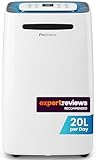

If you like the capacity of the 20L machine but don’t particularly need smart functionality, the standard Pro Breeze 20L/Day Dehumidifier is worth considering.
It retains many of the functions that matter most for everyday moisture management, including a digital humidity display, sleep mode, continuous drainage, laundry drying and a 24-hour timer.
This is the sort of machine we’d consider if condensation is regularly appearing on windows or you’re struggling to dry washing indoors without making your home feel damp.
A 20L dehumidifier can also be a more practical choice than a small machine if you want to move it between several rooms.
Key features
- 20L/day rated extraction
- Digital humidity display
- Sleep mode
- Continuous drainage
- Laundry drying
- 24-hour timer
- Designed for damp and condensation
Best for: Households wanting substantial moisture extraction without paying specifically for app connectivity.
View The ProBreeze 20/Day Dehumidifier
4. Pro Breeze 30L/Day Smart Dehumidifier – Best for Larger Homes
Sometimes 12L simply isn’t enough.
The Pro Breeze 30L/Day Dehumidifier is the heavy-duty option in this selection, with a rated extraction capacity of up to 30 litres per day.
That makes it the model we’d investigate first for a larger property or a home experiencing a substantial moisture problem.
It also adds Wi-Fi and app control, allowing you to manage the dehumidifier remotely.
There’s a large 4L water tank, continuous drainage, 24-hour timer and child lock.
If you’re dealing with persistent damp, substantial condensation or lots of indoor laundry, the additional extraction capacity could make the 30L model worth the investment.
Key features
- 30L/day rated extraction
- Wi-Fi connectivity
- Smart app control
- 4L water tank
- Continuous drainage
- 24-hour timer
- Child lock
Best for: Larger homes, substantial condensation and households needing high-capacity moisture extraction.
Check the Pro Breeze 30L Smart Dehumidifier on Amazon
5. Pro Breeze 20L OmniDry WiFi – Best Premium Pro Breeze Dehumidifier

The Pro Breeze 20L OmniDry WiFi combines the versatile 20L capacity with a more sophisticated smart feature set.
It has an automatic humidity sensor and display, sleep mode, laundry drying functionality and continuous drainage.
You can also control the machine through its smart app.
Another significant selling point is its Which? Best Buy Award, making the OmniDry particularly interesting if your search for the best rated dehumidifiers has brought you to the Pro Breeze range.
Key features
- 20L/day rated extraction
- Which? Best Buy Award
- Wi-Fi
- Smart app control
- Automatic humidity sensor
- Digital humidity display
- Sleep mode
- 24-hour timer
- Laundry drying mode
- Continuous drainage
Best for: Buyers wanting a premium combination of 20L extraction, automatic humidity management and smart controls.
View the Pro Breeze 20L OmniDry WiFi on Amazon
Pro Breeze 12L vs 20L vs 30L: Which Size Do You Need?
This is probably the most important decision.
Don’t assume that the largest machine is automatically the best dehumidifier for your home.
Choose a 12L Pro Breeze Dehumidifier if:
- You primarily want a dehumidifier for a bedroom
- You live in a smaller flat
- Your condensation problem is relatively modest
- You want everyday humidity management
- You value a more compact machine
The 12L model should be sufficient for many everyday domestic situations.
Choose a 20L Pro Breeze Dehumidifier if:
- You have persistent condensation
- You regularly dry laundry indoors
- You want to use the machine across several rooms
- You have a medium-sized home
- You want greater extraction capacity without moving to a 30L machine
For many buyers, 20L is likely to provide the best balance between capacity and everyday practicality.
Choose a 30L Pro Breeze Dehumidifier if:
- You have a larger home
- Your property suffers from significant excess humidity
- You have substantial condensation problems
- You regularly dry large amounts of laundry indoors
- You want a high-capacity machine
- Wi-Fi/app control appeals to you
Remember that the quoted litres-per-day figure represents extraction capacity under specified test conditions. Your machine won’t necessarily collect 12, 20 or 30 litres of water every day in normal UK household conditions.
What Humidity Should I Set My Pro Breeze Dehumidifier To?
For most homes, maintaining relative humidity somewhere around 40% to 60% is a sensible objective.
Around 50–55% RH can be a useful everyday target.
If humidity is consistently above 60%, conditions become more favourable for damp, condensation and mould.
This is why an automatic humidity sensor is so useful.
Rather than running your dehumidifier continuously regardless of conditions, you can select a target humidity level and allow the machine to respond accordingly.
Which Pro Breeze Dehumidifier Is Best for a Bedroom?
For a normal-sized bedroom, we’d start with the Pro Breeze 12L.
It combines sufficient capacity for many smaller-room applications with an automatic humidity sensor, digital display and sleep mode.
View the Pro Breeze 12L on Amazon
If the bedroom has a serious condensation problem or forms part of a larger damp property, however, a 20L model may be worth considering.
Noise also matters in a bedroom.
If you’re sensitive to sound when sleeping, don’t just compare extraction capacity. Look at operating noise and the availability of sleep/night modes before choosing.
Which Pro Breeze Dehumidifier Is Best for Drying Clothes?
We’d lean towards one of the 20L models for regular laundry drying.
Wet laundry releases a surprising amount of moisture into your home.
During winter, putting a clothes airer in a room and running a dehumidifier nearby can help extract that moisture while accelerating the drying process.
For larger households producing substantial amounts of laundry, the 30L model becomes more attractive.
Close the windows and external doors in the room while dehumidifying and follow the manufacturer’s positioning instructions.
Can a Pro Breeze Dehumidifier Help With Mould?
A dehumidifier can help prevent mould by controlling the excess humidity that encourages mould growth.
However, a dehumidifier isn’t a mould-removal machine.
If black mould is already growing, it needs to be dealt with appropriately and you should investigate why the area is damp.
Possible causes include:
- Condensation
- Poor ventilation
- Drying laundry indoors
- Plumbing leaks
- Penetrating damp
- Rising damp
- Cold walls or thermal bridging
If there’s an underlying leak or building defect, a dehumidifier may control some of the symptoms but won’t repair the source of the moisture.
For mould prevention, monitor relative humidity and try to keep it consistently below around 60%.
Where Should You Position a Home Dehumidifier?
Place the machine in the room experiencing the moisture problem and give it adequate space for airflow.
Don’t wedge it tightly behind furniture or curtains.
If you’re drying laundry, positioning the machine in the same enclosed room as the clothes can help it concentrate on extracting moisture from that space.
Keep external doors and windows closed while actively dehumidifying. Otherwise, the machine continually has to deal with incoming outside air.
If you’re trying to reduce humidity across several rooms, internal doors can be left open to encourage airflow, although controlling one enclosed room will generally be quicker.
Smart vs Standard Pro Breeze Dehumidifier
Do you actually need Wi-Fi?
For many people, no.
A standard dehumidifier with an automatic humidistat can already monitor humidity and operate according to your chosen settings.
However, smart control becomes useful if you want to:
- Check the dehumidifier remotely
- Adjust settings without being in the room
- Control a machine located elsewhere in the house
- Integrate dehumidification into your smart-home routine
If none of those things matter to you, choosing the standard version may offer better value.
Pro Breeze Dehumidifier FAQs
Are Pro Breeze dehumidifiers good?
The range includes several feature-rich compressor dehumidifiers, and selected models have received Which? Best Buy recognition. The right model depends primarily on room/property size and the amount of moisture you need to remove.
What size Pro Breeze dehumidifier should I buy?
A 12L model is a good starting point for bedrooms and smaller spaces. A 20L machine offers greater versatility for general household use and laundry, while 30L is better suited to demanding moisture problems and larger spaces.
What is the best Pro Breeze dehumidifier for a bedroom?
We’d choose the Pro Breeze 12L for many bedrooms because it combines a more modest capacity with an automatic humidity sensor and sleep mode.
Is a 20L dehumidifier better than a 12L?
Not necessarily. A 20L machine has greater extraction capacity, but a 12L dehumidifier may be perfectly adequate for a smaller room. Buying excessive capacity can mean paying for performance you don’t need.
Can I use a Pro Breeze dehumidifier to dry clothes?
Several Pro Breeze models include dedicated laundry drying functionality. A 20L machine is particularly attractive if indoor laundry drying is one of your main reasons for buying a dehumidifier.
Should I buy a smart dehumidifier?
Smart control is useful if you want remote access and app functionality. If you’re happy setting a target humidity level directly on the machine, it isn’t essential.
Can I leave my Pro Breeze dehumidifier running overnight?
Models with sleep modes and automatic humidity controls are designed with extended operation in mind, but always follow the operating and safety instructions supplied with your particular machine.
Which Pro Breeze Dehumidifier Should You Buy?
If you’re looking for a dehumidifier for a bedroom or smaller home, we’d start with the Pro Breeze 12L. Its automatic humidity sensor, sleep mode and Which? Best Buy recognition make it a particularly strong all-round package.
For most medium-sized homes, we’d step up to a Pro Breeze 20L dehumidifier. The additional extraction capacity is particularly useful for persistent condensation and drying laundry.
The 20L OmniDry WiFi is our premium 20L choice if you want app control alongside automatic humidity management.
Finally, the Pro Breeze 30L Smart Dehumidifier is the one to consider when your moisture problem – or your home – is substantially larger.
Ultimately, choosing the best home dehumidifier isn’t about buying the machine with the biggest number on the box.
Match the extraction capacity to the space and moisture problem, set an appropriate target humidity and let the dehumidifier keep that moisture under control.

