
Best Backup Generator for Home: Petrol Generators vs Portable Power Stations
Looking for the best backup generator for home use? Compare petrol generators and portable power stations from AIVOLT, maXpeedingrods, AFERIY, DJI and Jackery, plus whole house backup generator costs.
Best Backup Generator for Home: Quick Picks


A power cut can leave you without lighting, internet, refrigeration, phone charging and, depending on your home, potentially heating controls and other essential equipment.
But choosing the best backup generator for home isn’t simply a matter of buying the model with the biggest wattage.
There are three quite different solutions:
- Portable petrol generators – potentially powerful and capable of running as long as you have fuel, but noisy and strictly for outdoor use.
- Portable battery power stations – quiet, clean and usable indoors, but limited by battery capacity.
- Home standby generators – permanently installed systems capable of automatically powering some or much of a home, but considerably more expensive.
For many households preparing for occasional outages, I increasingly like the simplicity of a high-capacity LiFePO4 portable power station, particularly if it can also be charged from solar panels.
Here are five options worth considering.
1. AIVOLT 6000W Petrol Inverter Generator – Best Powerful Petrol Backup Generator
If your priority is substantial output rather than silence or indoor convenience, the AIVOLT 6000W Petrol Inverter Generator is the most powerful conventional generator in this selection.
The current product specification lists 6000W peak output and approximately 5500W continuous running power.
That gives it considerably more continuous output than the portable battery stations featured further down this guide.
A petrol generator can also keep producing power for as long as you can safely keep it fuelled.
That’s its biggest advantage over a battery.
If an outage lasts several days and you have a reliable fuel supply, you’re not restricted to the finite number of watt-hours stored inside a battery.
Key features:
- 6000W peak output
- Approximately 5500W running output
- Petrol powered
- Inverter technology
- Designed for home, outdoor and site use
- Portable rather than permanently installed
Best for: Longer outages, higher-power appliances and households prepared to store and manage petrol safely.
Check the AIVOLT 6000W Generator on Amazon
However, petrol generators come with a major safety limitation:
Never run one inside your home, garage or other enclosed or partially enclosed space.
The Health and Safety Executive warns that petrol-powered generators can create dangerous carbon monoxide concentrations within minutes in enclosed spaces. Northern Ireland’s HSENI similarly warns against using portable generators indoors, in garages or near doors and windows.
2. maXpeedingrods 3300W Inverter Generator – Best Smaller Petrol Generator


Not everybody needs 6000 watts.
The maXpeedingrods 3300W Portable Inverter Generator offers a more manageable petrol-powered alternative.
It produces a stated 3300W maximum output with 3000W continuous running power from its four-stroke petrol engine.
That’s potentially enough to run a useful selection of emergency appliances, depending on their individual power requirements.
Inverter technology is also attractive when powering more sensitive electronics because it is designed to provide a cleaner electrical output than some basic conventional generator designs.
Key features:
- 3300W maximum output
- 3000W running power
- Four-stroke petrol engine
- Pure sine-wave inverter output
- 230V outlets
- USB outputs
- Portable
Best for: Households wanting a smaller petrol emergency generator without moving to a 5kW+ machine.
View the maXpeedingrods 3300W Generator on Amazon
Again, this is an outdoor-only fuel-burning appliance, not something to run inside the garage with the door cracked open.
3. AFERIY P310 3840Wh Portable Power Station – Best Home Battery Backup Overall


The AFERIY P310 is the product I’d look at first if you want substantial emergency power without storing petrol.
It combines a large 3840Wh LiFePO4 battery with 3600W pure sine-wave output. AFERIY also states that the system can be expanded to as much as 11,520Wh using additional battery capacity.
That combination makes it considerably more than an oversized phone power bank.
A 3600W inverter can power many ordinary household appliances individually, while the 3840Wh battery gives you a meaningful reservoir of stored electricity.
There’s also a built-in UPS function and 13 output ports.
Key features:
- 3840Wh LiFePO4 battery
- 3600W output
- Expandable capacity
- Built-in UPS
- 13 outputs
- Solar-generator capability
- Seven-year warranty stated on the supplied listing
Best for: Serious home emergency backup without petrol, exhaust fumes or generator noise.
Check the AFERIY P310 on Amazon
For emergency preparedness, this type of machine has a big practical advantage:
You can use it indoors.
There’s no combustion engine producing carbon monoxide.
You can keep the power station inside and run a fridge, router, lighting, laptop or other equipment directly from it, provided you remain within the unit’s output and capacity limits.
4. DJI Power 2000 – Best Premium Compact Backup Power Station
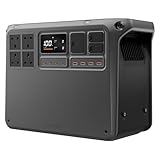


DJI is better known for drones, but its Power 2000 is a serious portable backup battery.
It combines a 2048Wh LFP battery with up to 3000W output. DJI also supports expansion batteries, taking maximum capacity as high as 22,528Wh.
That’s an interesting combination because the base unit is relatively compact, but the system can grow if your needs increase.
DJI supports mains, vehicle and solar charging.
A UPS function also allows the unit to provide backup power to connected equipment when the mains supply fails.
Key features:
- 2048Wh battery
- 3000W output
- LFP chemistry
- Expandable to over 22kWh
- Solar charging support
- AC and vehicle charging
- UPS functionality
- Multiple AC and USB outputs
Best for: Buyers wanting a premium, expandable battery system with strong power output.
View the DJI Power 2000 on Amazon
5. Jackery Explorer 2000 v2 – Best Straightforward Home Emergency Generator Alternative


Jackery is one of the best-established names in portable power stations, and the Explorer 2000 v2 is well suited to emergency home use.
It provides 2042Wh of LiFePO4 capacity with 2200W continuous output. Jackery also specifies a UPS switching time of under 20 milliseconds.
That makes it particularly attractive if your goal is keeping essential household devices operating during relatively short outages.
Jackery specifically positions the Explorer 2000 v2 for powering essentials such as refrigerators, Wi-Fi equipment and lighting.
Key features:
- 2042Wh battery
- 2200W output
- LiFePO4 chemistry
- UPS functionality
- Fast mains recharging
- Solar charging available
- Portable design
- No installation required
Best for: Refrigerators, routers, lights, laptops and other household essentials during outages.
Check the Jackery Explorer 2000 v2 on Amazon
Petrol Generator vs Portable Power Station: Which Is Better?
This is really the biggest decision.
Choose a Petrol Generator If:
- You need high continuous power
- Outages may last several days
- You can store fuel safely
- You have a suitable outdoor operating location
- Generator noise isn’t a major issue
- You need to run relatively demanding equipment
A petrol generator effectively carries its energy separately in the fuel tank.
Run out of petrol?
Add more.
That makes it potentially better for genuinely prolonged outages.
Choose a Portable Power Station If:
- You want silent backup power
- You want something usable indoors
- You primarily need to run essential appliances
- You don’t want to store petrol
- You want solar charging
- You expect shorter outages
- Ease of use matters
For a lot of households, I’d favour the battery solution.
Switch it on, plug in the appliances and use the stored electricity.
No engine.
No exhaust.
No refuelling.
No starting procedure.
No carbon monoxide.
Why Solar Power Stations Make Sense for Emergency Preparedness
A portable power station becomes much more interesting when you add solar panels.
Without solar, you’ve still got a finite battery.
Once the 2kWh or 4kWh stored inside it is gone, you need mains electricity, a vehicle or another charging source.
Solar gives you a way to replenish at least some of that energy during an extended outage.
Obviously, solar has limitations.
Winter days are shorter. Cloud reduces production. Panel orientation matters. And you shouldn’t assume a small portable panel will magically keep a whole house running indefinitely.
But it removes one of the weaknesses of a battery-only emergency setup.
Stored battery + solar recharging provides a renewable backup loop rather than depending entirely on stored petrol.
Why I’m Less Keen on Petrol Generators for Some Home Emergencies
Petrol generators are tremendously useful, but they introduce several dependencies.
You need:
- Petrol
- Safe fuel storage
- Engine maintenance
- Somewhere safe outdoors to run the generator
- Extension leads or appropriate professionally installed connections
- Enough distance from doors and windows
- Carbon-monoxide awareness
Fuel availability can also become an issue during a widespread disaster.
If many households suddenly need petrol at the same time, filling stations may themselves be affected by electricity, transport or supply problems.
They’re also noisy.
That doesn’t mean petrol generators are bad.
It means I’d choose one where long runtime and high output outweigh those disadvantages.
For phones, broadband, refrigeration, lighting and basic household electronics, I increasingly prefer battery storage.
How Much Backup Power Does Your House Actually Need?
Don’t start with the generator.
Start with the appliances.
Write down what you genuinely need during a blackout.
For example:
- Refrigerator/freezer
- Internet router
- Several LED lights
- Mobile phones
- Laptop
- Television
- Medical equipment where applicable
- Boiler controls/pumps where compatible
- Microwave or kettle occasionally
Then look at the running wattage and starting/surge requirements.
A refrigerator might consume relatively modest power once running but require a brief higher surge when its compressor starts.
High-power heating appliances are a completely different proposition.
Electric kettles, ovens, fan heaters and immersion heaters can rapidly consume a battery station’s available output and stored energy.
That’s why a 2000Wh battery doesn’t mean you can simply treat your house as though the grid were still working.
Emergency backup is about prioritisation.
Watts vs Watt-Hours: An Important Difference
These two numbers get confused constantly.
Watts (W) tell you how much power the system can deliver at one moment.
Watt-hours (Wh) tell you approximately how much stored energy a battery contains.
For example:
The DJI Power 2000 has roughly 2048Wh capacity and 3000W maximum output.
That means it can power relatively demanding appliances, but the battery doesn’t magically become larger because the inverter is powerful.
If you ran a theoretical constant 1000W load, 2048Wh represents roughly two hours of stored energy before allowing for inverter losses and other real-world inefficiencies.
Run only a 100W load and it could theoretically last vastly longer.
This is why capacity matters just as much as headline wattage when choosing home backup electrical generators.
How Big a Battery Do I Need for a Fridge During a Power Cut?
A refrigerator is one of the first appliances many people want to protect.
The exact requirement varies enormously according to the fridge, ambient temperature and how frequently the compressor runs.
Rather than relying on generic estimates, check the appliance’s label or measure its actual power consumption with an energy monitor.
A 2kWh power station such as the DJI or Jackery gives you a useful emergency reservoir.
The 3840Wh AFERIY P310 provides almost twice the nominal stored energy, which becomes particularly attractive if refrigeration is a priority during a longer outage.
View the AFERIY P310 on Amazon
Can a Portable Generator Run a Whole House?
Potentially, but that’s where terminology becomes misleading.
A portable 3000W generator may power several appliances.
That’s not necessarily the same as powering your entire house normally.
A typical home can easily exceed that if several high-demand appliances operate together.
You also shouldn’t simply connect a portable generator directly into household wiring through an improvised cable.
If you want a generator integrated into your home’s electrical system, use a competent electrician and an appropriate changeover/transfer arrangement.
The generator must never energise the public electricity network during an outage.
What Is a Home Standby Generator?
A home standby generator is a different category from every portable product in this guide.
It’s permanently installed outside the property and connected professionally to the home’s electrical system.
Many systems use an automatic transfer switch.
When mains electricity disappears, the generator starts and takes over selected electrical loads – potentially automatically.
When grid power returns, the system switches back.
This is the closest thing to genuinely seamless home generator backup.
The downside is cost.
Whole House Backup Generator Cost UK
If you’re researching whole house backup generator cost, expect a very different budget from buying a portable generator on Amazon.
Current UK cost guides put a professionally installed whole-house standby system broadly in the several-thousand-pound range.
Checkatrade’s 2026 guide estimates approximately £2,000–£10,000+ for the generator itself plus around £1,000 installation, giving a rough overall range of £3,000–£11,000 depending on specification and complexity.
MyBuilder gives a broader estimated installed range of around £3,000–£20,000, depending on capacity, site requirements and installation complexity.
So the difference is substantial:
Portable petrol generator: hundreds to perhaps low thousands.
Large portable battery station: typically hundreds to several thousand depending on capacity and expansion batteries.
Whole-home standby system: potentially many thousands.
A permanently installed system makes most sense where reliable uninterrupted power is genuinely important, not simply because you’d rather the television didn’t switch off during an occasional 45-minute outage.
Home Standby Generator vs Portable Generator
A standby generator offers:
- Automatic operation
- Permanent installation
- Much greater potential capacity
- Proper integration into household wiring
- Potential whole-house or large-load backup
A portable generator offers:
- Much lower purchase price
- Portability
- No permanent generator installation
- Flexibility for camping or work sites
- Manual deployment
The trade-off is convenience versus cost.
What Is the Best Emergency Generator for Home Use?
For most ordinary households, I think there are really two answers.
Best Petrol Emergency Generator
AIVOLT 6000W
The higher output makes it the more capable conventional generator in this selection.
Check the AIVOLT 6000W on Amazon
Best Battery Emergency Generator
AFERIY P310
Its 3840Wh battery and 3600W output make it the strongest combination of capacity and power among the battery units featured here.
Check the AFERIY P310 on Amazon
If portability matters more than maximum capacity, I’d look at the DJI or Jackery instead.
Can You Run a Petrol Generator in a Garage?
No.
Not even with the garage door open.
HSENI explicitly warns against running generators in garages and partially enclosed spaces and says they should not be operated near open doors and windows because carbon monoxide can enter the home.
Carbon monoxide is colourless and odourless.
You cannot rely on smell to warn you that something is wrong.
Keep combustion generators outdoors in a suitable location and follow the manufacturer’s clearance and weather-protection instructions.
Can You Use a Portable Power Station Indoors?
Battery power stations do not contain petrol engines and don’t create carbon monoxide through electricity generation.
That’s one of their biggest advantages for home backup.
They can be kept near the equipment you’re powering, although they still need to be used according to the manufacturer’s instructions, kept dry and given adequate ventilation for their electronics.
Should I Buy a Generator or Power Station for a Power Cut?
I’d use this simple rule.
Occasional short blackout:
Buy a portable battery power station.
Regular outage lasting hours:
Buy a larger 2–4kWh battery station, ideally with solar charging.
Potential multi-day outage where high power is essential:
Consider a petrol generator, potentially alongside a battery system.
Power must remain available automatically:
Investigate a professionally installed home standby generator.
Want genuine whole-house backup:
Get a proper electrical load assessment and quote for a professionally installed standby or home battery system.
Could You Combine a Petrol Generator and Battery Power Station?
Yes, and in some ways that’s the most resilient arrangement.
You could use a battery power station for:
- Overnight operation
- Indoor electronics
- Quiet periods
- Phones
- Internet
- Lighting
- Refrigeration
Then use an appropriately operated outdoor petrol generator when the battery needs replenishing or when running particularly demanding equipment.
Add solar and you have three potential energy sources:
stored battery + sunlight + petrol.
Emergency preparedness generally improves when you don’t rely on one single system.
What Should You Look for in the Best Home Electric Generator?
Output Power
Make sure it can support the appliances you intend to run simultaneously.
Battery Capacity
For power stations, compare watt-hours rather than looking only at inverter wattage.
Surge Capacity
Motor-driven appliances can briefly demand substantially more power when starting.
Pure Sine-Wave Output
Useful for sensitive electronics.
UPS Function
Particularly interesting if you want computers, routers or other equipment to switch automatically onto battery backup.
LiFePO4 Battery
Modern LFP/LiFePO4 batteries are widely used in larger power stations because of their long cycle life and thermal stability.
Solar Input
A major advantage during extended outages.
Expandable Batteries
Useful if you want to start with 2–4kWh and expand later.
Weight
A huge portable power station can cease to feel terribly portable.
Think about where you’ll store it and whether you can actually move it.
Best Backup Generator for Home FAQs
What is the best backup generator for home use?
For battery backup, we’d choose the AFERIY P310 from this selection because of its 3840Wh capacity and 3600W output. For conventional petrol generation, the AIVOLT 6000W provides substantially higher ongoing output while fuel remains available.
What is the best home electric generator without petrol?
A high-capacity portable power station is the obvious alternative. The AFERIY P310, DJI Power 2000 and Jackery Explorer 2000 v2 all use rechargeable lithium battery storage rather than a combustion engine.
What is the best home emergency generator?
It depends on outage duration. For shorter power cuts, a portable battery station is quieter and easier. For very long outages, a petrol generator can continue running as long as fuel is available.
How much does a whole house backup generator cost?
Current UK estimates suggest roughly £3,000 upwards, with some installations exceeding £10,000 depending on generator capacity and installation requirements.
Can a 3000W generator power a house?
It can power selected household appliances, but 3000W generally shouldn’t be interpreted as unrestricted whole-house operation. Add together the running and starting requirements of the appliances you intend to use.
What is a home standby generator?
It’s a permanently installed generator connected to the home’s electrical system, typically using an automatic or manual transfer arrangement to isolate the property from the electricity network and provide backup power.
Are solar generators good for home emergencies?
They can be excellent for essential electronics and appliances, particularly when paired with sufficient battery capacity. Their major advantage is the ability to replenish some stored electricity without depending on petrol or the electricity grid.
Is a power station the same as a generator?
Not technically. A battery power station stores electricity rather than generating it from fuel. The phrase solar generator is commonly used when a power station is paired with solar panels.
Can I use a petrol generator indoors?
No. Portable combustion generators can produce lethal carbon monoxide and should never be operated inside homes, garages or similar enclosed or partially enclosed spaces.
Which Backup Generator Should You Buy?
If you’re looking for the most powerful petrol emergency generator for home in this selection, the AIVOLT 6000W is the obvious choice.
Its approximately 5500W continuous output gives you considerably more running power than the battery systems here.
Check the AIVOLT 6000W Petrol Generator on Amazon
However, for my own emergency-preparedness setup, I’d be strongly tempted by the AFERIY P310.
Its 3840Wh battery, 3600W inverter, LiFePO4 chemistry and solar capability provide serious emergency electricity without requiring petrol or producing exhaust fumes.
View the AFERIY P310 Portable Power Station on Amazon
If you want something somewhat smaller, the DJI Power 2000 provides an impressive 3000W output from a 2048Wh system and can be expanded significantly later.
Check the DJI Power 2000 on Amazon
And if simplicity and a familiar portable-power brand matter most, the Jackery Explorer 2000 v2 is a compelling 2kWh alternative.
View the Jackery Explorer 2000 v2 on Amazon
For most households preparing for storms, floods, snow or an ordinary grid failure, I wouldn’t necessarily start with the question “How do I power my whole house?”
I’d start with:
What absolutely needs to keep working?
Keep the fridge cold, the router online, the phones charged, some lights running and essential equipment powered.
A 2–4kWh portable power station can handle that kind of emergency strategy remarkably neatly.
If your requirement really is whole-house backup with little or no interruption, that’s when it makes sense to move beyond portable Amazon generators and get quotes for a professionally installed home standby generator or integrated battery backup system.


