
Best Thermal Curtains for Winter: Keep Your Home Warmer
Looking for the best thermal curtains for winter? Compare thermal insulated curtains, thermal drapes, blackout curtains and thermal door curtains for a warmer home.
When winter arrives and temperatures plunge, windows and doors can become noticeable cold spots in the home. Thermal curtains offer a relatively inexpensive way to add another barrier between a warm room and a cold window.
The Energy Saving Trust specifically recommends thick or thermally lined curtains as one way to keep heat in during winter. It advises closing them at night while making sure they don’t cover radiators.
The best heavy thermal curtains for winter can also provide blackout benefits, making them particularly useful in bedrooms.
We’ve picked five options for different rooms and situations, including extra-large thermal drapes, a thermal door curtain and more conventional bedroom blackout curtains.
Best Thermal Curtains for Winter: Quick Comparison
| Thermal Curtains | Size | Best For | Type | Buy |
|---|---|---|---|---|
| BellaHills 100% Blackout Thermal Curtains | 90 x 90in | Best heavy thermal curtains | Blackout/thermal lined | View on Amazon |
| Deconovo Thermal Door Curtain | 52 x 84in | Best thermal door curtain | Single thermal/blackout panel | View on Amazon |
| Deconovo Grey Blackout Curtains | 46 x 54in | Best bedroom thermal curtains | 2-panel thermal/blackout | View on Amazon |
| Deconovo Pencil Pleat Blackout Curtains | 46 x 54in | Best pencil pleat option | Thermal/blackout pair | View on Amazon |
| Yorkshire Bedding Blackout Curtains | 66 x 72in | Best velvet option | Room-darkening/energy-saving | View on Amazon |
1. BellaHills 100% Blackout Thermal Insulated Curtains – Best Heavy Thermal Curtains for Winter
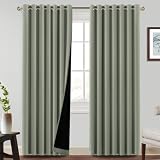
If keeping a cold room warmer is your priority, we’d start with the BellaHills Thermal Insulated Curtains.
These are substantial 90 x 90-inch curtains supplied as two panels and feature a black liner designed to provide 100% blackout.
The combination of large dimensions, blackout construction and thermal insulation makes them particularly interesting for larger bedroom and living-room windows.
They’re also pencil pleat curtains, providing a more traditional appearance than eyelet designs.
Key features:
- 90 x 90 inches
- Two panels
- Thermal insulated
- 100% blackout design
- Black liner
- Pencil pleat
- Dove grey
Best for: Large windows, bedrooms and living rooms where maximum coverage is a priority.
Check the BellaHills Thermal Insulated Curtains on Amazon
2. Deconovo Thermal Door Curtain – Best Thermal Door Curtain


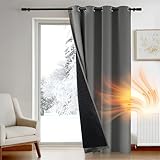
Windows aren’t the only potential source of heat loss and uncomfortable draughts.
Doors can also be problematic, particularly older external doors or glazed patio and balcony doors.
The Deconovo Thermal Door Curtain is a single 52 x 84-inch panel that combines blackout and thermal properties.
A thermal door curtain can provide an additional barrier between the room and a particularly cold door without requiring a major home improvement project.
This can be especially useful in rented properties where replacing doors or glazing isn’t an option.
Key features:
- 52 x 84 inches
- Single panel
- Thermal design
- Blackout properties
- Grey finish
- Suitable for doors and narrow openings
Best for: Cold doors, glazed doors and draught-prone entrances.
View the Deconovo Thermal Door Curtain on Amazon
3. Deconovo Grey Blackout Curtains – Best for Bedrooms


The Deconovo Grey Blackout Curtains provide a straightforward combination of thermal performance and room darkening.
This pair measures 46 x 54 inches, making them considerably smaller than the 90-inch BellaHills curtains.
That can make them better suited to standard bedroom windows where an enormous floor-length curtain would be unnecessary.
Combining blackout and thermal curtains also makes particular sense in bedrooms.
You want to reduce light when sleeping while simultaneously putting another layer of material between your warm bedroom and the cold glass.
Key features:
- 46 x 54 inches
- Two panels
- Blackout construction
- Thermal properties
- Grey finish
- Suitable for bedrooms
Best for: Smaller bedroom windows where you want both warmth and room darkening.
Check the Deconovo Grey Blackout Curtains on Amazon
4. Deconovo Pencil Pleat Curtains – Best Traditional Style


If you prefer pencil pleats to eyelets, this alternative Deconovo pair combines the more traditional hanging style with blackout functionality.
They measure 46 x 54 inches and come as a pair.
They’re another option for bedrooms and smaller living-room windows where you want the benefits of thermal insulated curtains without using oversized drapes.
Key features:
- 46 x 54 inches
- One pair
- Pencil pleat
- Blackout construction
- Grey finish
- Suitable for bedrooms
Best for: Traditional interiors and existing pencil-pleat curtain tracks.
View the Deconovo Pencil Pleat Curtains on Amazon
5. Yorkshire Bedding Blackout Curtains – Best Velvet Thermal-Style Curtains

Heavy fabric is particularly attractive when you’re looking for winter curtains.
These Yorkshire Bedding curtains use a super-soft velvet-style material and are marketed as both room-darkening and energy-saving curtains.
At 66 x 72 inches, they’re larger than the two smaller Deconovo options but more manageable than the 90 x 90-inch BellaHills curtains.
They’re supplied as two panels with tiebacks and use a ring-top design.
Key features:
- 66 x 72 inches
- Two panels
- Super-soft velvet
- Room darkening
- Energy-saving design
- Ring top
- Tiebacks included
Best for: Living rooms and bedrooms where you want heavier-looking winter curtains.
Check the Yorkshire Bedding Blackout Curtains on Amazon
Do Thermal Curtains Really Work?
Yes, but it’s important to understand what they’re actually doing.
Curtains aren’t a replacement for proper insulation or good-quality double or triple glazing.
Instead, thermal drapes provide an additional barrier at the window, helping reduce heat exchange and the uncomfortable cold sensation associated with poorly insulated glazing.
The Energy Saving Trust includes heavy thermal curtains among the options for making windows and doors more energy efficient and recommends thick or thermally lined curtains during winter.
They can therefore be particularly worthwhile if you have:
- Older windows
- Single glazing
- Large expanses of glass
- Draughty windows
- Patio or glazed doors
- A particularly cold bedroom
- A rented property where replacing windows isn’t practical
They’re a relatively simple intervention compared with replacing windows or undertaking major insulation work.
What Are Thermal Insulated Curtains?
Thermal insulated curtains are designed to create more of a barrier between the room and window than a thin decorative curtain.
Different manufacturers achieve this in different ways.
Some use multiple layers, while others incorporate a dense or specialised backing.
The important thing is that the curtain provides substantial coverage of the window.
For winter use, we’d generally favour a substantial, well-fitting curtain over a lightweight decorative one.


Blackout and Thermal Curtains: Are They the Same Thing?
Not necessarily.
Blackout curtains are primarily intended to prevent light passing through the window covering.
Thermal curtains are intended to reduce heat transfer.
However, the features frequently overlap.
The dense, multi-layered construction required to block light can also provide useful thermal properties, which is why you’ll frequently see products marketed as blackout and thermal curtains.
For a bedroom, the combination is ideal: less unwanted light at night and an additional thermal barrier during cold weather.
Heavy Thermal Curtains for Winter
If winter warmth is the priority, we’d generally lean towards heavier thermal curtains with good window coverage.
Size is important.
A beautifully insulated curtain isn’t going to perform as effectively if it’s too small and leaves substantial areas of the window exposed.
Ideally, curtains should provide generous coverage around the window while still being practical to open and close.
There is one important exception:
Don’t allow long curtains to cover an operating radiator underneath the window.
The Energy Saving Trust specifically warns against blocking radiators with curtains because doing so prevents the heat from circulating effectively into the room.
Thermal Door Curtains: Are They Worth It?
A thermal door curtain can be particularly useful in an older home.
External doors can create draughts and cold spots, while doors containing large glazed sections present some of the same problems as windows.
Installing a heavy curtain across the inside provides another barrier that can be closed during cold evenings and opened during the day.
It’s also a relatively inexpensive and reversible solution, making it interesting for renters.
The Deconovo 52 x 84-inch single panel in this guide is the obvious option if covering a door rather than a conventional window is your priority.
View the Deconovo Thermal Door Curtain on Amazon
What About Thermal Blackout Roller Shades?
Curtains aren’t your only option.
Thermal blackout roller shades or blinds can be particularly useful where curtains aren’t practical or where you want a cleaner, more minimalist appearance.
They can also be combined with curtains.
A well-fitting thermal blind close to the window plus a substantial pair of curtains creates two layers between the room and the glazing.
However, fit matters with both blinds and curtains. Large gaps around the edges provide a route for air and heat movement.
Thermal Curtains vs Regular Curtains
Almost any substantial curtain can provide some benefit compared with leaving a window completely uncovered at night.
The advantage of purpose-designed thermal curtains is their heavier or multi-layered construction.
For winter use, look for:
- Thermal lining
- Multiple layers
- Thick fabric
- Blackout backing
- Generous dimensions
- Good coverage around the window
- A suitable length
Don’t overlook the final point.
Buying a pair of premium thermal drapes that doesn’t properly cover your window defeats much of the purpose.


How to Use Thermal Curtains in Winter
Getting the most from thermal curtains is largely about when and how you use them.
During daylight hours, open curtains where sunlight can naturally warm the room.
As temperatures fall in the evening, close them to create an additional barrier at the window.
For best results:
- Measure your windows carefully before buying. Allow enough width for good coverage rather than stretching the curtains completely flat.
- Close the curtains as temperatures fall. Don’t wait until the room is already freezing.
- Open them during sunny winter days to benefit from solar heat.
- Keep them closed overnight.
- Don’t cover radiators. Keep the curtain above or behind the radiator arrangement as appropriate.
- Deal with obvious draughts too. Curtains shouldn’t be expected to compensate for major gaps around windows and doors.
Draught-proofing and insulation remain important because reducing unwanted gaps helps prevent warm air escaping and cold air entering.
Best Thermal Curtains FAQs
What are the best thermal curtains for winter?
Look for thick, well-fitting thermal insulated curtains with generous window coverage. From our selection, the BellaHills 100% Blackout Curtains are our pick for large windows and heavy winter coverage.
Do thermal curtains keep cold out?
They provide an additional insulating barrier at windows and can reduce the uncomfortable effects of cold glazing and draughts. They won’t repair poor glazing or replace proper home insulation.
Are blackout curtains thermal?
Some are, but not automatically. Look specifically for products described as both blackout and thermal curtains if you want both benefits.
Are thermal curtains good for bedrooms?
Yes. Bedrooms are particularly well suited to thermal blackout curtains because you can benefit from both reduced light and additional insulation around the windows.
Should thermal curtains touch the floor?
Long curtains can provide generous coverage, but don’t allow them to obstruct radiators. The correct length depends on your window, radiator and curtain arrangement.
Are thermal door curtains effective?
A substantial thermal door curtain can add another barrier across a cold or draught-prone doorway. For significant draughts, also investigate draught-proofing around the door itself.
Are thermal blackout roller shades better than curtains?
Neither is automatically better. A close-fitting thermal blind can be effective and takes up less space, while heavy curtains provide substantial coverage. Using a blind and curtains together can provide an additional layer at particularly cold windows.
Which Thermal Curtains Should You Buy?
For a large window where winter warmth is the priority, we’d choose the BellaHills 100% Blackout Thermal Insulated Curtains. Their 90 x 90-inch dimensions, two-panel construction and blackout lining make them our pick for heavy thermal curtains for winter.
Check the BellaHills Thermal Curtains on Amazon
For bedrooms with smaller windows, the Deconovo 46 x 54-inch Thermal Blackout Curtains provide a more compact option.
View the Deconovo Bedroom Curtains on Amazon
And if the problem is a cold external or glazed door rather than a window, we’d consider the Deconovo Thermal Door Curtain.
View the Deconovo Thermal Door Curtain on Amazon
Thermal curtains won’t transform a poorly insulated house by themselves. But when the temperature drops, closing a substantial pair of thermally lined curtains at night is one of the simplest ways to add another layer between your warm room and cold windows.

