
Jackery Explorer 1000 v2: Is It Enough for a Winter Power Cut?
 A power cut is a good time to discover what you really need electricity for. Keeping a phone charged and a few lights on is one thing. Trying to keep the whole house running normally is quite another.
The Jackery Explorer 1000 v2 sits between a pocket power bank and a much larger home-backup system. This guide looks at whether that middle ground makes sense for winter outages and occasional trips away.
Affiliate disclosure: this article contains affiliate links. We may earn a commission at no extra cost to you. As an Amazon Associate, we earn from qualifying purchases.
This is a researched buying guide, not a hands-on test. Specifications checked on 6 October 2026; runtimes below are calculations, not measured results.
Jackery Explorer 1000 v2: quick verdict
I would consider it for a defined list of essential devices, particularly if you also want portable electricity away from home. I would not choose it on the assumption that it can run every appliance you normally use during an outage.


Check the Jackery Explorer 1000 v2 on Amazon. Confirm whether the offer is the power station alone or a solar-panel bundle.
The main numbers
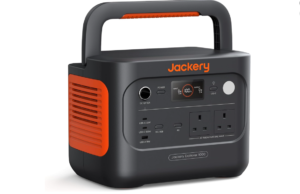
Jackery specifies a 1,070Wh battery and 1,500W rated output for the Explorer 1000 v2. These describe different things: stored energy and the power it can supply at a moment in time.
Source: Jackery’s official Explorer 1000 v2 product information.
That distinction matters more than a dramatic photograph of a power station beside several appliances. You need enough output for the equipment you connect, and enough stored energy for the time you want it to run.
Start with an emergency shopping list
Before spending money, decide what you want to protect. Make a short list of actual devices, their power requirements and how long they need to operate.
Phones, lighting and a laptop might be your priorities. A fridge introduces another question: its starting demand and cycling consumption. Check the equipment rather than relying on a generic “powers a fridge” claim.
For a wider view of supplies, read our UK emergency preparedness checklist. A battery is one part of a plan, alongside food, water, communications and knowing what to do during a disruption.
How long could it run your equipment?
A basic calculation is battery capacity divided by the load. Using the stated 1,070Wh capacity gives these theoretical figures:
| Constant load | Capacity ÷ load | How to read it |
|---|---|---|
| 50W | 21.4 hours | Arithmetic illustration, not a guaranteed runtime |
| 100W | 10.7 hours | Actual runtime is lower once losses are allowed for |
| 500W | 2.14 hours | High loads use the available energy quickly |
| 1,000W | 1.07 hours | A large load leaves much less endurance |
Real use includes conversion losses, the station’s own consumption and changing appliance demand. Temperature and battery condition can also affect performance. Measure your devices if runtime is an important purchasing decision.
This is why I would prioritise a few useful essentials. An electric heating appliance can consume the battery far faster than modest lighting or charging jobs, provided each connected load is compatible.
What should you avoid assuming?
First, a portable battery is not automatically a whole-house backup system. Plug compatible devices directly into the appropriate outputs and follow the manual. Do not improvise a connection into household wiring.
Second, do not assume a claimed peak or surge figure can support a demanding appliance continuously. Check rated output, startup demand and the manufacturer’s compatibility guidance.
Third, critical equipment needs a plan appropriate to its consequences if power fails. Do not make a consumer battery your only contingency for life-critical needs.
Is solar charging worth adding?
The attraction is obvious: a way to replenish energy when mains electricity is unavailable. The practical question is what the panel can deliver in your location and conditions.
A winter emergency purchase should not depend on ideal summer sunshine. Short days, cloud and panel positioning affect what you can collect. A panel’s rated wattage is not a promise of constant output.
Check panel compatibility, included cables and whether the listing actually contains a panel. “Solar generator” can describe a bundle or a solar-compatible power station, so read the contents carefully.
Would a larger power station be better?
It depends on the job. If your list of essentials requires more energy, buying a smaller unit simply because it looks portable can be false economy. If you only need modest loads for short interruptions, paying for much more capacity may be unnecessary.
Our Jackery range guide is the next place to compare models. For the wider choice between batteries and fuel-powered equipment, see our home backup generator guide.
What to check on Amazon
- Exact model: Explorer 1000 v2, not an older Explorer 1000 or another similarly named version.
- UK version: suitable sockets and supplied charging equipment.
- Bundle contents: station alone, panel package or extra accessories.
- Seller and condition: check new versus used, returns and warranty arrangements.
- Real requirements: capacity and output compared with the devices on your list.
For checking offers, our Amazon deals guide can help. I have not verified a current Amazon sales rank or monthly sales count for this model, so this recommendation is based on its preparedness use and specification, not a claim that it is today’s bestseller.
My recommendation
The Explorer 1000 v2 is worth shortlisting when your plan is specific: keep selected compatible devices running for a calculated period, then recharge when conditions allow.
If that is your aim, compare the Jackery Explorer 1000 v2 offers on Amazon. Buy against your power list, not against a vague promise of being ready for everything.
Quick questions
Can it run an electric heater?
Only if the heater’s demand is compatible with the station’s limits. High-power heating uses stored energy quickly, so calculate the requirements first.
Will a solar panel keep it full all winter?
Do not assume so. The energy collected depends on conditions, location and the panel setup.
Do I need the largest bundle?
Only if its contents match your plan. Extra equipment is useful when it solves a clear problem.
Featured image: illustrative camping scene by Matheus Bertelli on Pexels; it does not show the Jackery product.


