The power of passport… it’s best to have two
 The power of passport… it’s best to have two
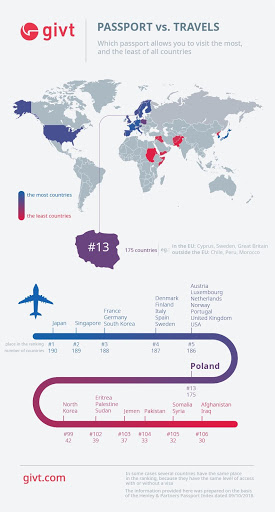
Which passports are ranked 1st in the world? Those issued in Japan. Why? Their holders can access 190 countries visa-free. According to The Henley Passport Index (HPI), a global ranking positioning the passports by the number of countries which can be accessed by their holders without visas, no other passports are as „effective” as the Japanese ones. The Polish passports also open many borders – to as many as 175 countries, thus holding 13th place in the HPI.
The runner-up is Singapore whose citizens can travel without visas to 189 countries across the world. In third place is Germany, France and South Korea, and their citizens have access to 188 countries visa-free. The bottom spot is held by the identity documents issued by Afghanistan and Iraq, which allow their holders to enter only 30 countries without a visa.
Poland is among the leaders
The Polish passport, ranked 13th in the latest HPI, is getting more and more powerful. In 2015, it was ranked 16th, and since then it has been moving up one spot each year. The lowest position that it held, 17th, was in 2012.
Here’s a quick comparison: this year, the American passport is in the 5th place, with 186 visa-free destinations, and the Russian passport holds 47th place, with 119 destinations accessible visa-free. Worth noticing is that the identity documents issued by the United Arab Emirates have claimed from 62nd place (in 2006) to 21st place (this year), which is a remarkable success.
Despite the fact that there exist areas such as the Schengen Area, in which citizens of the member countries do not need passports to travel, passports are still the most useful identity documents for all travellers abroad. In many countries, visas are still required, and visa stamps are placed in the passports. Although the Polish passport allows you to travel visa-free to as many as 175 countries, you need to remember that there is also a long list of countries which still require Polish citizens to have visas, e.g. the USA, Cuba, India, Russia and Australia.
Know your rights
“Before the trip, it is useful to check carefully if you are going to need a visa, and also to become familiar with the passenger rights, which can vary depending on the destination, e.g. if you fly across the EU or across Asia only,” says Paulina Krogulec, Head of Airlines Relations at the GIVT technology platform helping airline passengers to obtain compensation for disrupted flights. It may happen that a carrier, when selling tickets, fails to inform passengers about the requirement of having a visa or buying a visa at the airport. The consequences can be really frustrating, especially if you find out at the airport that you do not have a full set of documents with you. According to the EC Regulation 261/2004, when facing disturbances such as a flight delay of three hours or more, a cancelled flight,
or denied boarding during a planned trip abroad, a passenger holding, among others, a Polish passport, is entitled to claim compensation. “In this case, it should be determined by which airline the flight was operated and on which territory it was held,” Paulina Krogulec emphasizes.
Two passports – zero worries
Instead of getting a visa, it is sometimes a better idea to… take two passports with you. This works great for those who have citizenship in two or more countries. What about a Polish person who wants to travel with two passports? You need to remember to always bring your Polish passport with you, even if you intend to enter a country using a document from another country. This will guarantee a trouble-free return to your homeland. This is due to the fact that border guards have the right not to allow a person holding a passport of another country, who is also, or above all, a Polish citizen, to enter Poland. It’s clear that dual citizenship is an excellent way to increase your personal and economic freedom but be sure to consult an expert when doing to ensure you understand the rules, regulations and restrictions around this passport status.
Travelling the world – still with passport, but without borders
Documents allowing for crossing the borders separating national territories have a long history. The first passport holders were ancient Roman merchants, and the passports were designed to ensure safety for the transport of goods. It was not until the beginning of the 20th century that passports became travel documents in most countries. After World War II, in the Eastern and Central European countries under the influence of the Soviet Union, very few people were allowed to hold passports (e.g., in 1950, in Poland, only 181 people were given passports and went abroad for private reasons). Looking at the traffic at Polish airports and border crossings today, this number just seems completely unbelievable.
The Henley Passport Index was created in 2006, and it is based on the IATA (International Air Transportation Association) data, including 199 passports and 227 destinations. The index is updated in real time, which means that it records all changes in the visa policy of individual countries on an ongoing basis. It is considered to be the most reliable source of this type of information for citizens all over the world.
Related Articles