7 Strategies To Improve Your Interview Technique
 A survey from interviewmastery.com has found that it can take an average of 17 interviews to get a job.
Of course, this is just an average and some people will sadly be taking far more than 17 interviews to get a job, but many more fortunate people will be taking far less than 17 interviews to get a job. They may have an interview strike rate of say 3, 4 or 5 interviews per job offer. This is of course where you all want to be. And to maximize your interview to offer strike rate you need to adopt an excellent interview technique but as well as this, in a tough market, you need to adopt interview strategies that clearly market your talent and set you apart from the competition.
Below, I have outlined 7 interview strategies you can adopt to help to help improve your interview technique.
1.Make a strong first impression. Research from Harvard University shows that interviewers make their mind up about you within the first 30 seconds of meeting you. You must therefore make a strong impression of meeting by engaging in a firm handshake, (at least matching the pressure applied by the other party), by maintaining eye contact while shaking, and by smiling and looking positive.
2.Make regular eye contact during the interview. A survey by comerecommended has found that 67% of employers cite that ‘failure to make regular eye contact is a common non-verbal interview mistake – so make to make regular eye contact during the interview
3.Research the company prior to the interview. 47% of employers in the comerecommended survey cite that the most common mistake made by candidates is having little or no knowledge of the company prior to interview – so do your employer background research prior to interview.
4.Prepare for behavioural interview questions. Most employers use behavioural interview questions which means you are required to show your competency not by explaining how you would address an issue but by demonstrating how you have successfully addressed the issue in a past real working situation. It is possible to both anticipate the question topics you may face and to prepare model answers prior to interview and this article explains how to do this.
5.Prepare for and practice aptitude tests
Studies show that over 80% of the FTSE 100 and the majority of large companies all over the world use aptitudes as part of the interview and selection process. So, there is a good chance you may face an aptitude test if going for a role at a bigger company. The good news is that you can prepare for aptitude tests by practising them and this can improve your performance at interview. Read my article here to find out how to prepare for aptitude tests.
6.Ask questions at the end of interview; most employers will expect you to ask pertinent questions, usually at the end of the interview, but there is no steadfast rule. If you don’t ask pertinent questions you can appear disinterested which will not reflect well on your candidacy. Therefore, prepare interview questions in advance of the interview which you can ask the employer. You can find examples of good questions to ask here.
7.Follow-up
After the interview, make sure that you send the employer a polite follow-up email thanking them for their time at interview and re-confirming your interest in the role. If you feel that you answered a question insufficiently during the interview or failed to demonstrate skills that you feel you possess, now is the time to make amends and explain that you did not feel you made yourself clear on this question and give the improved response.
For more information on interview techniques, take a look at this highly informative and hot off the press infographic from acuity training.
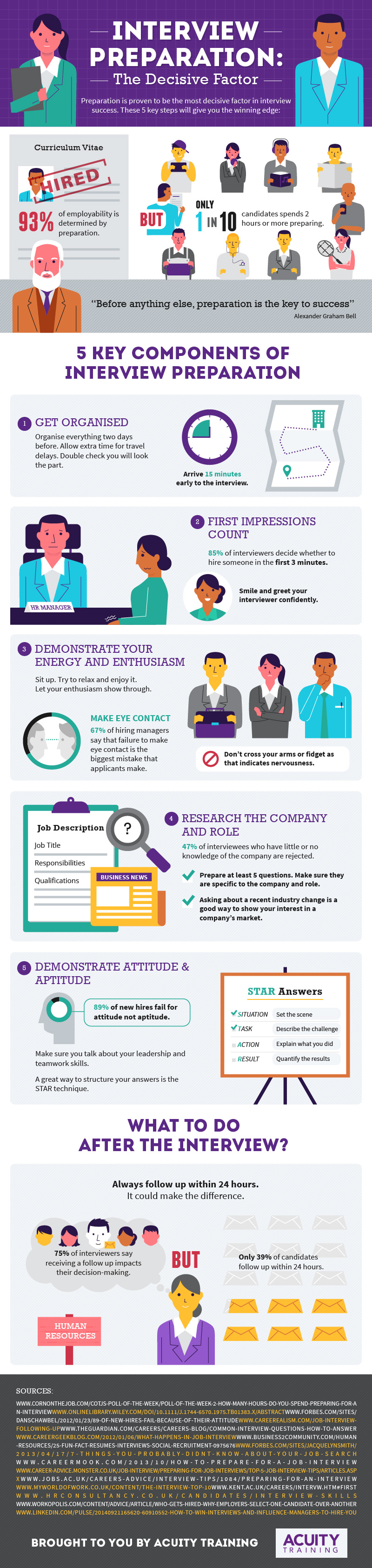
- 3 Main Tips To Remember Ahead of Interviews
- 7 Deadly Sins That Interviewees Commit – and how to avoid them